Forestry Mulching in Delaware County, OH
Clear standing growth in a single pass and leave the mulch behind as erosion control.
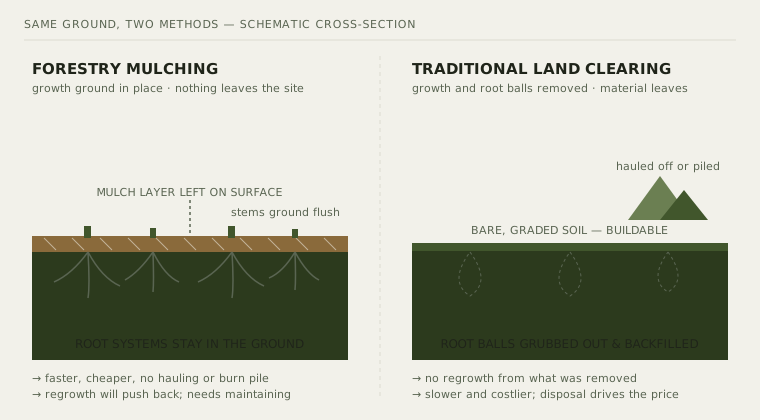
Forestry mulching uses a rotating drum head to grind standing vegetation where it stands. Brush, undergrowth, and trees up to several inches in diameter go down and come out as mulch spread across the ground.
It is usually the cheapest way to reclaim overgrown ground, for a simple reason: there is no burn pile, no trucking, and no disposal fee. The material never leaves the property. The mulch layer that stays behind holds soil, suppresses regrowth for a while, and breaks down over the following seasons.
What it does not do is remove root systems. Everything is cut off at or near grade and the roots stay in the ground. That is completely fine for reclaiming a view, a trail, a fence line, or a hunting parcel, and it is not enough if something is getting built or finish graded there.
We are fully licensed and insured. Work is performed by experienced local crews. Proof of credentials, recent project photos, and references are available on request.
Where Mulching Is the Right Call
- Overgrown acreage — reclaiming ground that has gone to brush, without a disposal bill.
- Trails and access paths — cutting a usable path through wooded property.
- Fence lines and boundaries — clearing a line so it can be maintained going forward.
- Food plots and hunting ground — opening a plot with the mulch left in place as cover.
- Erosion-sensitive ground — the mulch layer holds soil where bare dirt would wash.
- Licensed & insured — proof of credentials and insurance available on request.
Food Plot Clearing in Delaware County
Opening a food plot is one of the jobs forestry mulching suits best, and it comes up steadily on the rural end of Delaware County. The typical parcel is ground that was pasture or field at some point, went unmanaged, and has since filled with honeysuckle, autumn olive, multiflora rose, and volunteer cedar and locust. You want an open, plantable area inside cover, and you want it without a burn pile or a line of trucks hauling material out.
Mulching handles that in a single pass. The standing growth goes down where it stands and comes out as a mulch layer across the plot. For a food plot that residue is not a nuisance, it is useful: it holds soil on ground that has just been stripped of cover, and it breaks down into organic matter over the following seasons. Most plot work we do is somewhere between a quarter acre and a couple of acres, shaped to the ground rather than squared off, because the edge is doing as much work as the middle.
The honest limitation is roots. Mulching cuts at or near grade and leaves the root systems in place, so a mulched plot is not a seedbed on day one. If you intend to drill or broadcast into it you will want to plan a follow-up pass, and depending on how heavy the stumps and root mass are, some tillage or a light grade. We would rather set that out before the work than have you discover it at planting.
Timing is worth thinking about too. Clearing well ahead of the season you intend to plant gives the mulch time to settle and the first flush of resprout something to be dealt with on a second pass, rather than competing with a new planting.
Acreage and Pasture Reclamation
The other common mulching call is straightforward reclamation: acreage that has gone to brush and needs to be usable again. Old pasture is the classic case. Once grazing or mowing stops, woody growth moves in from the edges, and within a handful of seasons a field that was open is a thicket with a few volunteer trees through it.
Mulching is normally the cheapest route back, and the reason is disposal. Conventional clearing generates material that has to go somewhere, and on acreage the haul-off or burn cost can rival the clearing itself. Mulching produces nothing to remove. On larger parcels that difference compounds quickly, which is why the cost gap between the two methods widens as the job gets bigger rather than staying proportional.
What mulching will not do is prepare ground for construction or a finish grade. If a building, a pad, a pond, or a driveway is going in, the root systems have to come out and the ground has to be left at a workable grade, and that is full clearing work rather than mulching. The comparison guide walks through where that line sits, and the Delaware County cost guide covers how the numbers move.
Trails, Fence Lines and Boundaries
Linear work suits a mulching head well. Cutting a trail through a wooded parcel, reopening a fence line that has not been maintained in years, or clearing a boundary so a survey line can actually be walked are all jobs where the machine moves along a corridor and leaves the material behind it.
Fence lines are the most frequent of these. A line that has gone unmanaged carries honeysuckle and grapevine into the wire, and eventually the fence becomes both invisible and unrepairable. Mulching the corridor gets access back so the fence can be assessed and fixed, and keeping that corridor open afterward is far less work than reclaiming it a second time.
On boundary work it is worth being precise about where the line actually is before anything runs. If you are not certain, we would rather see a survey pin or a plat than guess, because clearing across a line you did not own is not a problem either of us wants.
What Grows Back, and How Fast
Every honest answer about mulching has to deal with regrowth. The root systems survive the pass, so the species that resprout will resprout. In central Ohio that means Amur honeysuckle first and most vigorously, along with multiflora rose, autumn olive, and locust. The mulch layer suppresses seed germination for a period, which slows things, but it does not stop what is already rooted.
Practically, a mulched area stays visibly open for a season or so, then starts showing resprout at the stumps. Ground you want to keep open wants either periodic maintenance, a mowing regime once the growth is small enough to mow, or full removal of the root systems if you want it gone permanently. Which of those makes sense depends entirely on what the ground is for.
Anyone telling you a single mulching pass is permanent on honeysuckle ground is overselling the method. The method is excellent at what it does. It is not a herbicide and it is not stump removal.
Ground Conditions, Slope and Access
Mulching equipment is tracked and handles rough and sloping ground better than most machinery, which is part of why it works on parcels that would be awkward to clear conventionally. On erosion-sensitive slopes the method has a real advantage: the mulch layer goes down as the cover comes off, so the ground is not left bare through the next rain.
Saturated ground is the practical limit. Working wet is how you get rutting and soil damage, and on a parcel with any slope that is also how you start an erosion problem rather than preventing one. We schedule around ground conditions instead of forcing a date, which occasionally means a job moves.
Access decides feasibility on smaller and enclosed parcels. The machine has to physically reach the work, which means gate widths, bridges and culvert crossings, and soft field entrances all get looked at before we quote rather than discovered on the morning.
When Mulching Is the Wrong Tool
It is worth stating plainly, because it saves everyone a wasted visit. Mulching is the wrong choice when the root systems have to come out: building pads, driveways, ponds, anything that will be finish graded, and anything where settlement over a buried root mass would be a problem later.
It is also the wrong choice for genuinely mature timber. Mulching heads are built for standing growth up to several inches in diameter. A mature tree is a removal, not a mulching job, and trying to force it is slow and hard on equipment.
And it is not a fix for a drainage problem. If the reason a piece of ground is unusable is that water sits on it, clearing the growth off will not change that. Grading and yard leveling is the relevant work there. When we look at a property we will tell you which of these you actually have, including when the answer is that mulching is not what you need.
Licensed, Insured & Local Experts
We are fully licensed to operate in Ohio and carry comprehensive general liability insurance. Proof of licensing and current insurance certificates are available on request — simply ask when we provide your free written estimate.
The work is performed by experienced local professionals who specialize in land clearing for Delaware and surrounding communities. We know the local conditions and standards.
Real results and reviews build trust. See real transformations on the Results & Reviews page. Request your free estimate and we’ll share recent before-and-after photos from comparable jobs in your area plus customer references. On-page Google reviews and job-site proof are priorities as we grow our local track record.
Why Choose Delaware County Land Clearing
We’re local to Delaware, fully licensed and insured, and committed to careful work and honest pricing. You’ll get a clear written estimate before we start and a clean property when we finish.
Forestry Mulching — Questions, Answered
How big a tree can be mulched?
Mulching heads handle standing growth up to several inches in diameter comfortably. Past that it becomes slow and hard on equipment, and a mature tree is genuinely a removal job rather than a mulching one. We will tell you which side of that line your property falls on.
Does the mulch need to be raked out or removed?
Normally no. Leaving it is the point — it is erosion control and it breaks down on its own. If you are seeding soon afterward, a heavy mulch layer can be spread thinner so seed reaches soil.
Will everything grow back?
Some will, because the root systems are still there. The mulch layer suppresses regrowth for a while but it is not permanent. Ground you want to stay open needs occasional maintenance, or full clearing with root removal if you want it gone for good.
Are you licensed and insured?
Yes. We are fully licensed and carry liability insurance. Proof of license and insurance is available before work begins — just request it with your estimate.
Can I see real reviews or recent work?
Of course. See real transformations on the /reviews/ page. Request a free estimate and we will send recent before-and-after photos from similar jobs in the area plus references. Google reviews and on-site proof are part of our process.
Do you clear food plots in Delaware County?
Yes, and it is one of the jobs mulching suits best. Overgrown pasture or field ground gets opened in a single pass and the mulch stays on the plot as cover and erosion control. Most plot work runs between a quarter acre and a couple of acres.
Can I plant a food plot straight after mulching?
Not usually straight away. Mulching cuts at or near grade and leaves root systems in the ground, so a freshly mulched plot is not a seedbed. Plan on a follow-up pass and, depending on how heavy the root mass is, some tillage or a light grade before planting.
How far ahead of planting season should a plot be cleared?
Clearing well ahead of the season you intend to plant is better. It gives the mulch time to settle and lets the first flush of resprout be handled on a second pass instead of competing with a new planting.
Can you reclaim old pasture that has gone to brush?
Yes, that is one of the most common acreage jobs. Once grazing or mowing stops, woody growth moves in from the edges and a field closes in within a few seasons. Mulching is normally the cheapest route back because there is nothing to haul off or burn.
Is mulching cheaper than conventional clearing on acreage?
Usually, and the gap widens as the parcel gets bigger. The saving is disposal: conventional clearing produces material that has to be burned or trucked out, and mulching produces none. That said, if the ground is going to be built on, mulching cannot replace full clearing.
Can you clear an overgrown fence line?
Yes. A fence line that has gone unmaintained carries honeysuckle and grapevine into the wire until the fence cannot be assessed or repaired. Mulching the corridor restores access, and keeping it open afterward is much less work than reclaiming it twice.
Our Other Services
Serving Delaware, Powell, Lewis Center, Sunbury and all of Delaware, Ohio.
Get a Free Forestry Mulching Estimate
Fast, friendly, no-obligation quotes for homeowners in Delaware, Ohio.